Best Temperature for Sleep: The Science of Cooling
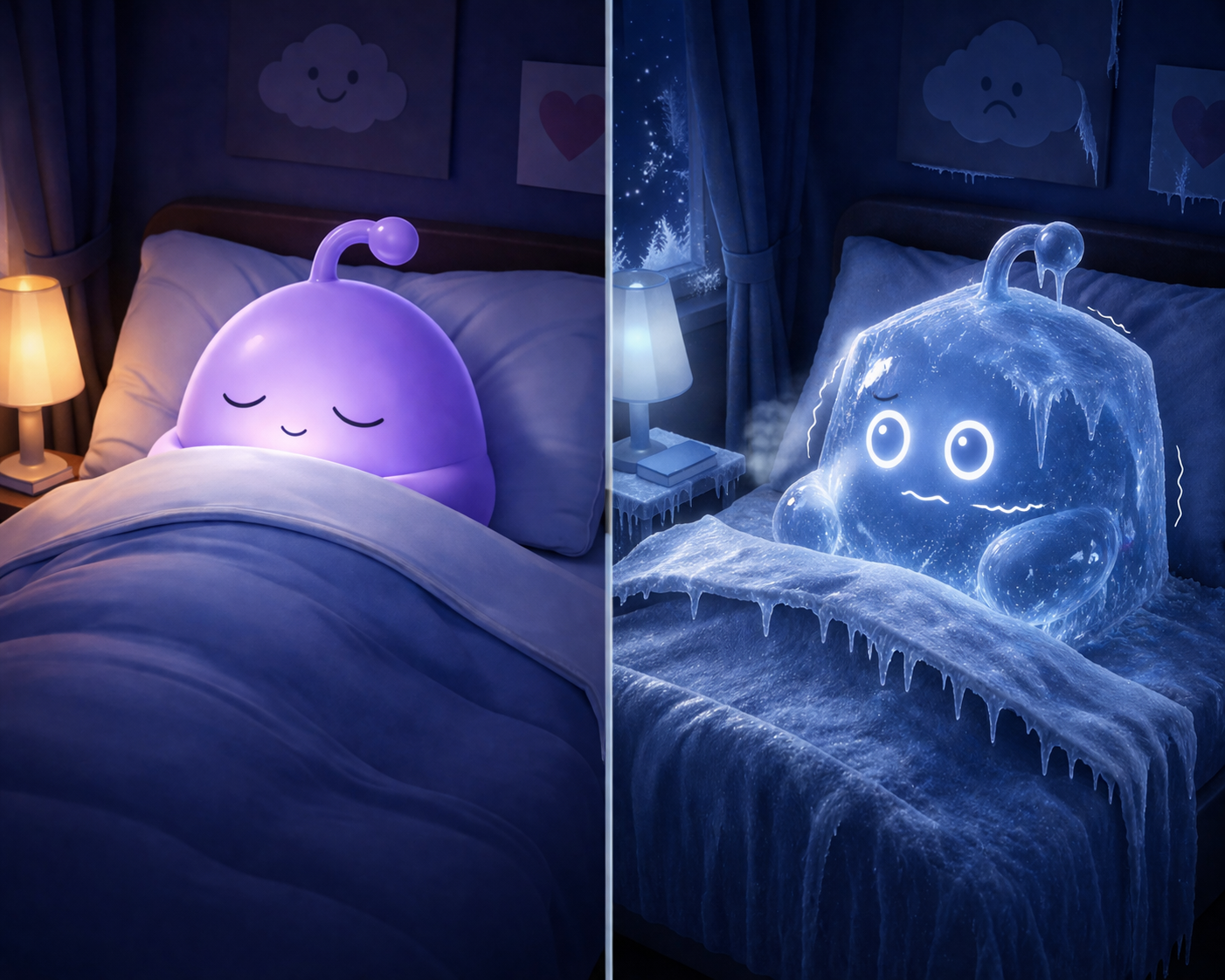
The best temperature for sleep is 60 to 67°F (15 to 19°C). This is not just about comfort. Your body needs to lower its core temperature by 2 to 3°F to initiate sleep, and a bedroom that is too warm actively interferes with that process. Understanding how temperature and sleep are linked gives you a direct lever for improving both how fast you fall asleep and how deeply you sleep.
TL;DR
The ideal bedroom temperature for sleep is 60 to 67°F (15 to 19°C) — your body must drop its core temperature by 2 to 3°F to initiate sleep, and a warm room blocks this. Heat above 86°F (30°C) reduces both slow-wave and REM sleep, while high humidity above 70% prevents sweat evaporation, keeping your core temperature elevated. A warm bath at 104°F (40°C) taken 90 minutes before bed shortens sleep onset by an average of 10 minutes by triggering rapid post-bath cooling (Haghayegh et al., 2019).
Why Does Your Body Temperature Need to Drop to Fall Asleep?
Sleep is not something you choose to begin — it happens when your body is ready. The central mechanism in that readiness is core body temperature drop. About two hours before your natural bedtime, your body begins dilating peripheral blood vessels in your hands and feet to radiate heat outward. As core body temperature falls by roughly 2 to 3°F (1 to 1.5°C), the brain receives the signal to initiate sleep.
This mechanism is managed by the thermoregulatory center in the hypothalamus. In the evening, this center coordinates falling body temperature in parallel with rising melatonin levels. As reviewed in a key paper on temperature dependence of sleep published via NIH (Raymann et al., 2008), each NREM sleep episode is accompanied by cooling of both the brain and the body's core.
A warm bedroom blocks this cooling. When your core temperature cannot drop far enough, the brain keeps receiving signals that sleep conditions are not met. If you lie in bed tossing and turning, room temperature is one of the first variables worth checking.
The Ideal Sleep Temperature Range: 60-67°F (15-19°C)
Sleep Foundation and multiple sleep medicine organizations recommend maintaining bedroom temperature between 60 and 67°F (15 to 19°C). This range supports the body's natural cooling process without triggering cold-stress arousal, which can fragment sleep in the other direction.
A 2023 study on nighttime ambient temperature and sleep in community-dwelling older adults (PMC10529213, Okamoto-Mizuno et al.) found that sleep was most efficient when the nighttime temperature ranged between 68 and 77°F (20 to 25°C), with a clinically relevant 5 to 10% drop in sleep efficiency when temperature increased from 77°F (25°C) to 86°F (30°C).
Individual variation matters. Women tend to prefer bedroom temperatures 1 to 2°C warmer than men due to slightly higher baseline body temperature. Infants and older adults are more sensitive to temperature fluctuations. If you share a bed with a partner who has different temperature preferences, separate bedding layers or a dual-zone mattress pad can resolve the conflict.
How Does Heat Steal Your Deep Sleep and REM?
During sleep, your body's ability to regulate temperature changes by stage. During REM sleep, thermoregulatory behaviors like sweating and shivering are largely suspended. Your body becomes essentially ectothermic, dependent on ambient temperature. If the room is warm, your body temperature rises during REM, which activates arousal mechanisms and fragments sleep.
Research published in the journal SLEEP by Haskell and colleagues demonstrated that continuous heat exposure at 95°F (35°C) reduced the mean duration of REM episodes and shortened REM cycle length compared to 68°F (20°C) conditions. Slow-wave sleep (SWS), the deepest and most restorative stage, also decreased under heat exposure.
A 2024 systematic review published in Sleep Medicine Reviews analyzed ambient heat and sleep across dozens of studies. The conclusion was consistent: rising nighttime temperatures are associated with delayed sleep onset, reduced deep sleep, and increased nighttime awakenings. The impact was disproportionately large for populations without access to air conditioning. For a closer look at what each sleep stage does for your health, see our guide to sleep stages.
"During REM sleep, the body largely stops regulating its own temperature. A warm room means your temperature rises with it — and your brain wakes you up."
Summary of thermoregulation research (Haskell et al., SLEEP journal)
Cooling Strategies That Actually Work
Air conditioning is the most direct solution, but it is far from the only one. Understanding the thermoregulatory mechanism opens up several effective strategies that work regardless of whether you have AC.
- Warm bath or shower 1-2 hours before bed (the warm bath paradox)
A 2019 meta-analysis by Haghayegh and colleagues in Sleep Medicine Reviews analyzed 17 studies and found that bathing in 104 to 109°F (40 to 42.5°C) water for at least 10 minutes, scheduled 1 to 2 hours before bed, shortened sleep onset latency by an average of 10 minutes. Warm water dilates peripheral vessels and rapidly exports core body heat. The optimal window is about 90 minutes before bedtime.
- Bedroom ventilation: block daytime heat, open at night
Keep curtains or blackout blinds closed during the day to block solar heat gain. Once outdoor temperature drops below indoor temperature at night, open windows to cross-ventilate. A fan does not lower room temperature, but it accelerates sweat evaporation from skin, which directly helps core temperature dissipation.
- Switch to breathable bedding
Natural materials like cotton, linen, and bamboo wick moisture and release heat faster than synthetic fibers. If you sleep hot, synthetic bedding compounds the problem. Your pillow matters too: standard memory foam traps heat. Gel-infused memory foam or latex pillows improve airflow significantly.
- Cooling mattress pads or wearable thermoregulation devices
Water-circulating cooling mattress pads directly lower bed surface temperature, which is in contact with your body all night. They are especially useful when partners have different temperature preferences. A 2025 study published via PMC (PMC12524338) on adaptive thermal regulation reported measurable improvement in sleep quality using these devices.
These cooling strategies are one part of a broader sleep environment optimization. For a complete checklist covering light, noise, and pre-bed habits alongside temperature, see our sleep hygiene checklist.
Humidity Matters Just as Much as Temperature
Even with an ideal room temperature, sleep degrades when humidity is too high or too low. The optimal range for bedroom relative humidity is 40 to 60%. Outside this range, your body's ability to regulate temperature is directly compromised.
High humidity above 70% blocks sweat evaporation. Sweat is your body's primary cooling mechanism during sleep; if the air is already saturated with moisture, sweat cannot evaporate and your body temperature stays elevated. A 2025 study on humidity and CO2 effects on older adult sleep (ScienceDirect) found sleep quality was highest at 60% relative humidity, with both 40% and 80% associated with worse sleep outcomes.
Low humidity below 30% disrupts sleep through a different pathway. Dry mucous membranes cause nasal congestion, coughing, and throat irritation, all of which increase nighttime awakenings. Winter heating often drops indoor humidity below 30%. A humidifier that maintains 40 to 60% solves this without overshooting into territory that blocks evaporative cooling.
A digital hygrometer and thermometer, available for $15 to 30, gives you real data on both variables simultaneously. Sensory judgment alone is unreliable for humidity — measuring is the necessary first step.
Seasonal Adjustments for Year-Round Sleep Quality
The temperature problem changes with the seasons, and so do the most practical solutions.
Summer strategy: daytime heat blocking plus night cross-ventilation is the foundation. If using AC, pre-cool the bedroom before you sleep and set it to hold around 66°F (19°C) through the night. Continuous AC often drops humidity too low; pair it with a humidifier or use a sleep timer to reduce runtime after midnight. Adding a foot soak in cool water to your bedtime routine accelerates the core temperature drop.
Winter strategy: when indoor temperature falls below 59°F (15°C), cold-stress arousal can fragment sleep just as heat does. Keep bedroom heating in the 60 to 67°F (15 to 19°C) target range and avoid overheating. Layering lighter blankets rather than using one heavy duvet gives you finer temperature control during the night. Maintain breathable bedding materials even in winter — the goal is insulation without heat trapping.
During seasonal transitions in spring and fall, your thermoregulatory system may take 1 to 2 weeks to recalibrate, and temporary sleep disruption during that adjustment is normal. For a broader look at what improves sleep depth beyond temperature, see our guide to sleeping deeper.
References
- Haghayegh S, Khoshnevis S, Smolensky MH, Diller KR, Castriotta RJ. Before-bedtime passive body heating by warm shower or bath to improve sleep: A systematic review and meta-analysis. Sleep Medicine Reviews. 2019;46:124-135. DOI: 10.1016/j.smrv.2019.04.008
- Raymann RJ, Swaab DF, Van Someren EJ. Cutaneous warming promotes sleep onset. European Journal of Neuroscience. 2007;25(6):1863-1870. DOI: 10.1111/j.1460-9568.2007.05405.x
- Okamoto-Mizuno K, Mizuno K. Effects of thermal environment on sleep and circadian rhythm. Journal of Physiological Anthropology. 2012;31(1):14. DOI: 10.1186/1880-6805-31-14
- Haskell EH, Palca JW, Walker JM, Berger RJ, Heller HC. The effects of high and low ambient temperatures on human sleep stages. Electroencephalography and Clinical Neurophysiology. 1981;51(5):494-501. DOI: 10.1016/0013-4694(81)90226-1
- Sleep Foundation. The Best Temperature for Sleep. sleepfoundation.org
- NIH National Library of Medicine. The Temperature Dependence of Sleep. PMC6491889. pmc.ncbi.nlm.nih.gov
Written by
piliq Sleep Science TeamEvidence-based content grounded in sleep research and clinical data.
piliq tracks your sleep stages alongside environmental data through the night. See exactly how bedroom temperature affects your deep sleep in your own data.