What Is NSDR? How to Recover Without a Nap
NSDR, short for non-sleep deep rest, is a category of guided relaxation practices that restore your brain and body without requiring you to fall asleep. In 10 to 20 minutes, it can lower your stress hormones, sharpen your focus, and boost dopamine levels, all while you stay awake.
TL;DR
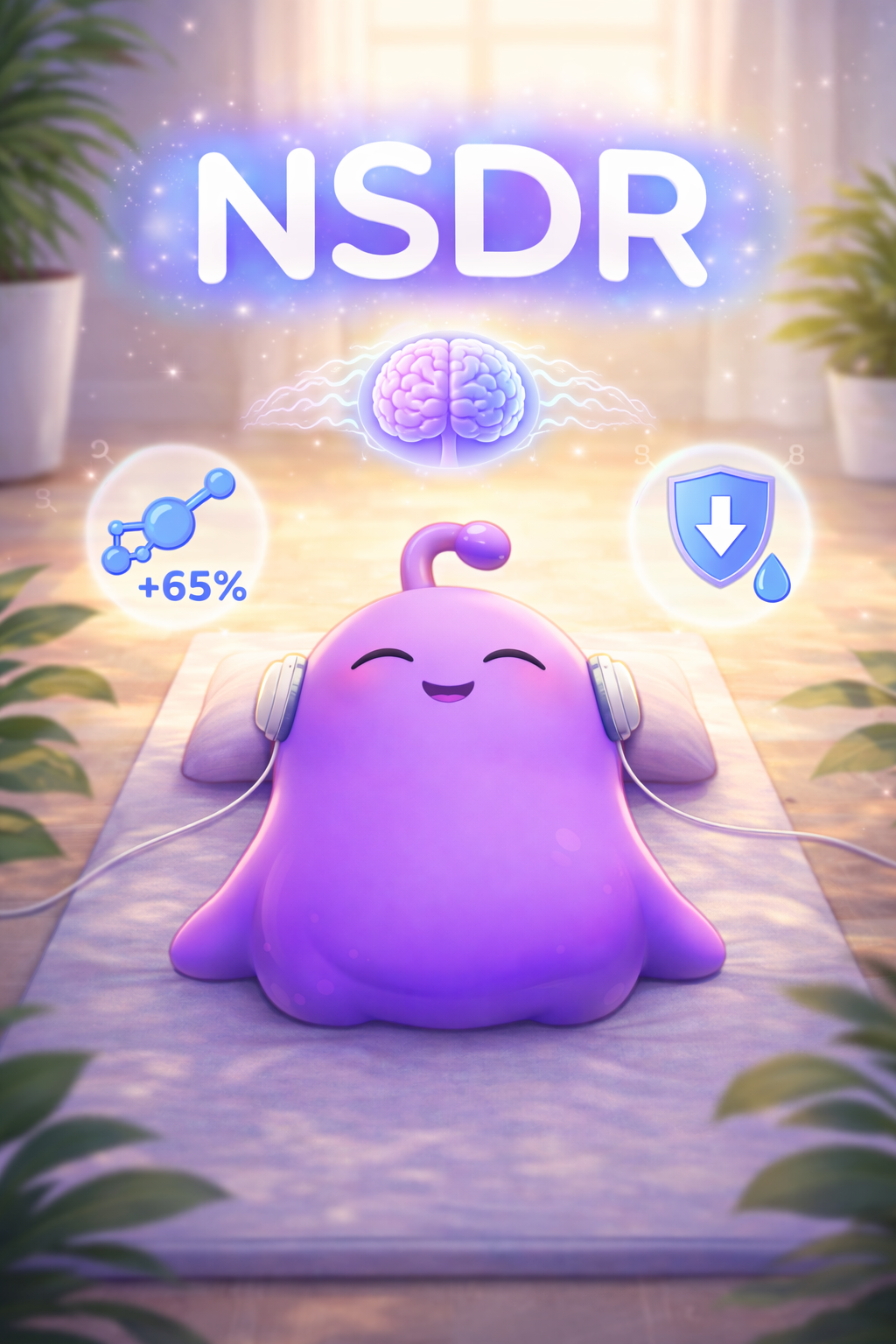
NSDR (non-sleep deep rest) is a 10–20 minute waking rest practice that puts your brain into a theta-wave state similar to light sleep. A 2002 PET imaging study found yoga nidra raises endogenous dopamine by 65%. A 2025 RCT showed daily practice lowers cortisol over two months. NSDR beats naps for stress and mood recovery; a 25-minute nap wins for raw fatigue. You can do a valid 10-minute NSDR session with nothing but a floor, closed eyes, and a free audio guide.
What Is NSDR and How Is It Different from Yoga Nidra?
NSDR is an umbrella term coined by Andrew Huberman, a neuroscientist at Stanford University. He uses it to describe any practice that shifts the nervous system into a state of deep, deliberate rest while the person remains conscious. The three main practices that fall under the NSDR umbrella are yoga nidra, body scan meditation, and slow-paced breathwork.
Yoga nidra is the oldest and most studied of the three. It originated in ancient Indian yogic tradition and literally means "yogic sleep." A trained guide (or audio recording) leads you through a systematic scan of body sensations, breath awareness, and visualizations. The goal is to stay at the precise edge between wakefulness and sleep, a state called hypnagogia, without crossing over into actual slumber.
So what is the difference between NSDR and yoga nidra? Yoga nidra is a specific, structured practice with roots going back thousands of years. NSDR is the modern scientific framing of that same physiological state. Think of yoga nidra as the original recipe, and NSDR as the name scientists and wellness professionals now use to describe what that recipe produces in the brain.
Google CEO Sundar Pichai has publicly said he practices NSDR daily. His candid mention in a 2023 interview helped push the term into mainstream conversation, though the science behind it had been building for two decades.
What Does NSDR Do to Your Brain and Body?
The most striking finding in the research comes from a 2002 neuroimaging study by Kjaer and colleagues at the University of Copenhagen. They used PET scans to measure brain chemistry in 8 experienced yoga nidra practitioners. During a session, the binding of 11C-raclopride in the ventral striatum dropped by 7.9%. That drop corresponds to a 65% increase in endogenous dopamine release: the brain's own dopamine, not from any external substance.
Dopamine is commonly associated with reward and motivation, but its less-discussed role is in directing attention and keeping you mentally sharp. The 65% surge may be why people who finish an NSDR session often describe feeling more motivated and clear-headed, not just relaxed.
On the stress side, a 2025 randomised controlled trial published in Stress and Health by Moszeik, Rohleder, and Renner tested 362 participants across four groups: an 11-minute yoga nidra group, a 30-minute yoga nidra group, an active control group that listened to music, and a waitlist control. After two months of daily practice, both yoga nidra groups showed significantly lower total cortisol and a steeper, healthier diurnal cortisol slope compared to controls. The 11-minute group performed comparably to the 30-minute group, which is good news for busy schedules.
At the brain-wave level, yoga nidra consistently generates theta waves (4–8 Hz) in the frontal and occipital lobes. Theta activity is the same pattern your brain produces in the first few minutes after you fall asleep, the stage associated with creative insight and memory consolidation. Staying in theta while awake is essentially giving your brain the neurological benefits of early sleep without losing consciousness.
Heart rate and blood pressure also respond during NSDR. Studies consistently report parasympathetic nervous system activation: heart rate slows, breathing deepens, and the muscles relax progressively. This is the direct opposite of the sympathetic fight-or-flight response that chronic stress keeps activated.
"A single 10-minute session can restore dopamine by 65%. No drugs, no nap required."
Based on Kjaer et al. (2002), PET neuroimaging study.
NSDR vs. a Nap: Which Is Better and When?
The honest answer is: it depends on what you need.
A 2024 study by Boukhris and colleagues, published in Applied Psychology: Health and Well-Being, assigned 65 physically active participants to either a 10-minute NSDR session or 10 minutes of passive sitting. The NSDR group showed significant improvements in handgrip strength, reaction time, cognitive accuracy, physical readiness, emotional balance, overall recovery, and stress levels compared to the control group.
But a 2026 preprint (medRxiv) directly compared a 25-minute nap to a 10-minute NSDR session in 60 young adults. At 40 minutes post-intervention, the nap group reported lower fatigue and higher readiness to perform than both the control and the NSDR group. For raw fatigue and physical readiness, the longer nap outperformed the shorter NSDR session.
Here is a practical way to think about it:
Choose NSDR when:
- You have 10–15 minutes and cannot sleep (at a desk, between meetings, on a flight)
- Your main problem is stress, anxiety, or mental fog rather than sleepiness
- You need to be fully alert immediately after the session (NSDR has no sleep inertia)
- You want to build a daily recovery habit without disrupting nighttime sleep
Choose a nap when:
- You have 20–25 minutes and a quiet place to lie down
- Your main problem is physical fatigue or drowsiness
- You are not worried about post-nap grogginess affecting the next hour
For a full breakdown of nap lengths and their trade-offs, see our guide on how long you should nap.
The good news is that NSDR and napping are not competing strategies. Many people use NSDR on workdays and reserve longer naps for weekends.
How to Do a 10-Minute NSDR Session (Step by Step)
You do not need any equipment, a yoga mat, or prior meditation experience. Here is a simple protocol:
- Step 1: Choose your position (1 minute)
Lie flat on your back with your arms slightly away from your body, palms facing up. If lying down is not possible, sit in a chair with your back supported and your feet flat on the floor. Close your eyes. - Step 2: Set a soft anchor (1 minute)
Take 3–4 slow breaths through your nose. If you are new to breathwork, the 4-7-8 breathing technique works well here: inhale for 4 counts, hold for 7, exhale for 8. This activates the parasympathetic nervous system and signals to your brain that it is safe to slow down. - Step 3: Body scan from feet to head (4–5 minutes)
Move your attention slowly through your body, spending about 10–15 seconds on each region. Feel the weight of your feet. Notice your calves, knees, thighs. Feel your lower back, belly, chest. Move to your hands, forearms, upper arms, and shoulders. Then your neck, jaw (let it drop), eyes (soften them), and forehead. Do not try to relax each area by force. Just notice the sensations. - Step 4: Rest in stillness (3–4 minutes)
Once you have scanned your full body, let go of the deliberate attention. Simply rest. If thoughts arise, notice them without engaging and return your awareness to the feeling of your body against the floor or chair. This is the window where theta waves emerge and dopamine recovery occurs. - Step 5: Reactivate slowly (1 minute)
Wiggle your fingers and toes. Take a deeper breath. Open your eyes slowly. Sit up without rushing. Give yourself 60 seconds before looking at a screen.
The entire protocol takes 10 minutes. Longer sessions (20–30 minutes) deepen the effect, but 10 minutes is enough to produce measurable changes in mood and cognitive performance, as shown in the Boukhris 2024 study.
How to Make NSDR Part of Your Daily Routine
Consistency matters more than duration. The Moszeik 2025 RCT that measured cortisol reduction had participants practice daily for two months. Occasional sessions help in the moment, but the hormonal and neurological changes accumulate with regular practice.
The best time windows for NSDR:
- Post-lunch (1–3 PM): The natural circadian dip in alertness makes this the easiest time to reach the theta state. It also resets the second half of your workday.
- After exercise: The body is already in a physiological cool-down phase, making deep relaxation easier to reach.
- Before bed if you cannot sleep: NSDR lowers the hyperarousal that keeps many people awake. Unlike a nap, a 15-minute NSDR session in the evening does not push your sleep timing later.
Practical tips:
- Use a free guided audio (search "NSDR guided" or "yoga nidra 10 minutes" on YouTube or a podcast app). The Huberman Lab website also provides a free 10-minute NSDR protocol.
- Set a gentle alarm so you are not checking the clock.
- Keep a consistent start time for the first two weeks. Your nervous system learns to down-regulate faster once the habit is established.
- If you track your sleep, you may notice your sleep efficiency score improving after two to four weeks of daily NSDR. Lower afternoon cortisol makes it easier for the brain to wind down at night.
The barrier to starting is genuinely low. You need a quiet space for 10 minutes and nothing else. Most people who try it once and feel the post-session clarity become regular practitioners within a week.
Frequently Asked Questions
Can NSDR replace sleep?
No. NSDR cannot substitute for the full neurological work of a complete sleep cycle. Deep sleep stages produce memory consolidation, cellular repair, and glymphatic waste clearance that waking rest cannot replicate. Think of NSDR as a high-quality top-up between sleep periods, not a replacement for 7–9 hours at night.
Is NSDR the same as a guided meditation?
They overlap but are not identical. General mindfulness meditation often trains focused attention on breath or a mantra and keeps the mind alert. NSDR specifically guides the nervous system toward the hypnagogic threshold, the body-asleep, mind-awake state, and maintains that edge rather than redirecting attention away from it. The physiological targets (theta waves, dopamine release, parasympathetic activation) distinguish NSDR from standard mindfulness.
How quickly does NSDR work?
Many people notice reduced stress and sharper thinking after a single 10-minute session, which aligns with the Boukhris 2024 lab findings. Deeper benefits, including sustained cortisol reduction, improved sleep quality, and better mood baseline, develop over weeks of daily practice, as shown in the Moszeik 2025 RCT.
References
- Kjaer TW et al. (2002). “Increased dopamine tone during meditation-induced change of consciousness.” Cognitive Brain Research, 13(2), 255–259. DOI: 10.1016/S0926-6410(01)00106-9.
- Boukhris O et al. (2024). “The acute effects of nonsleep deep rest on perceptual responses, physical, and cognitive performance in physically active participants.” Applied Psychology: Health and Well-Being, 16(4), 1967–1987. DOI: 10.1111/aphw.12571.
- Moszeik EN, Rohleder N, Renner K-H. (2025). “The Effects of an Online Yoga Nidra Meditation on Subjective Well-Being and Diurnal Salivary Cortisol: A Randomised Controlled Trial.” Stress and Health, 41, e70049. DOI: 10.1002/smi.70049.
- Baird B et al. (2023). “A closer look at yoga nidra: Early randomized sleep lab investigations.” Sleep Medicine Reviews, 67, 101725. DOI: 10.1016/j.smrv.2022.101725.
- Comparing the effects of a short nap and non-sleep deep rest on perceptual, cognitive, and physical performance in active adults. medRxiv preprint. DOI: 10.64898/2026.03.03.26347495v1. (2026, March).
piliq measures your nightly sleep quality in depth. If you are using NSDR regularly, you may start to see the downstream effects in your sleep data: lower nighttime restlessness, faster sleep onset, and more stable deep sleep.