Sleep and Your Immune System: How Poor Sleep Makes You Sick More Often
Yes, poor sleep really does make you sick more often. The link between sleep and immune system health is one of the most well-researched areas in sleep science, and the evidence is clear: skimping on sleep leaves your body's defenses significantly weakened.
TL;DR
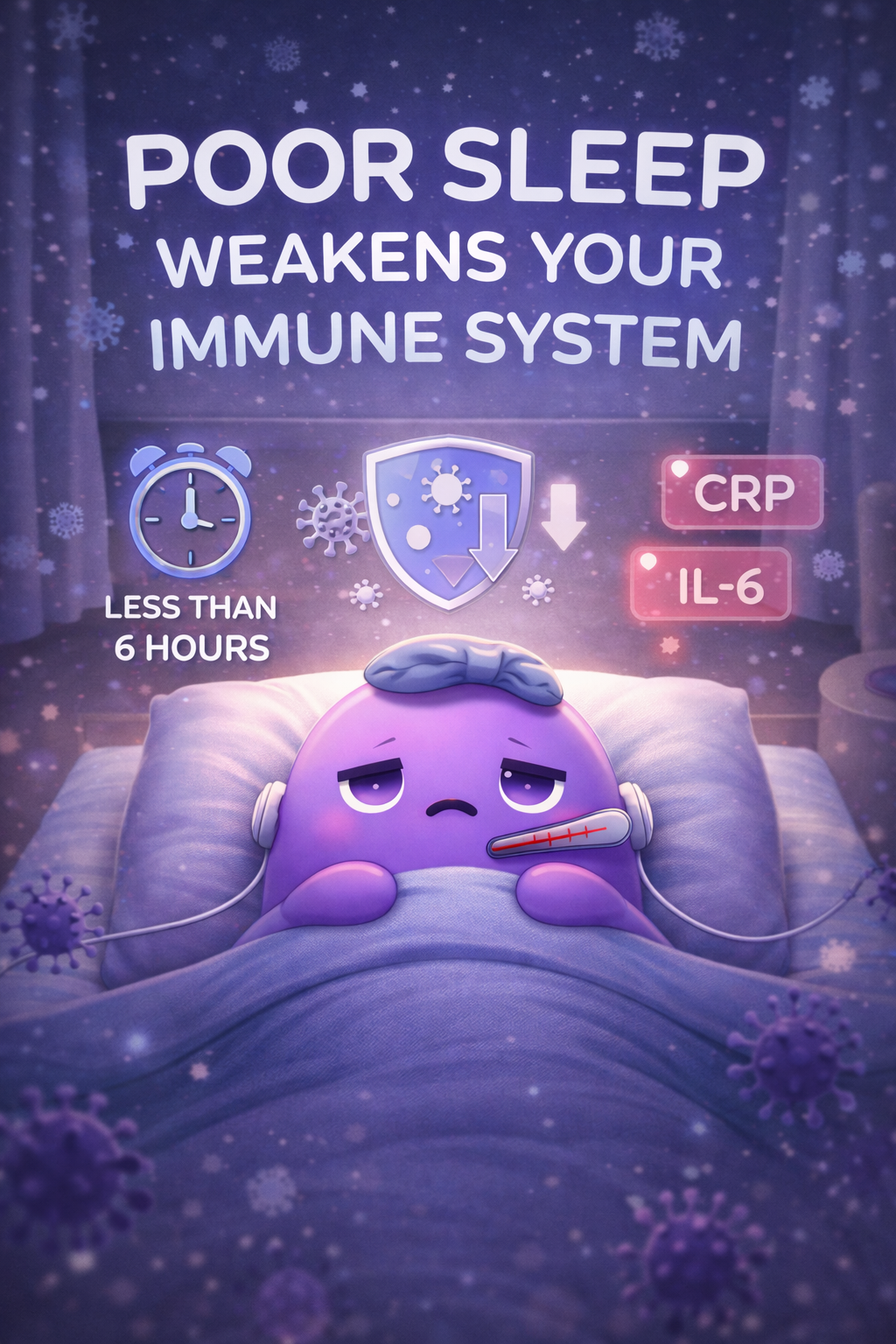
People sleeping under 6 hours a night are 4.2x more likely to catch a cold than those sleeping 7 or more hours. During sleep, your body produces cytokines and mobilizes T cells, critical weapons against infection. Chronic short sleep raises CRP and IL-6, inflammatory markers linked to heart disease and diabetes. Adults need 7 to 9 hours for optimal immune function. Consistent sleep timing, a cool bedroom, and avoiding alcohol before bed are among the most evidence-backed strategies to strengthen your immune defenses through sleep.
What Does Your Immune System Do While You Sleep?
While you sleep, your immune system is anything but idle. Sleep is actually prime working hours for your body's defenses.
During the early stages of sleep, particularly during deep slow-wave sleep, your body releases a surge of growth hormone and suppresses the stress hormone cortisol. This hormonal environment is ideal for immune activity. Your body ramps up the production of cytokines, which are small proteins that act like messenger molecules, coordinating the immune response across your whole body. Some cytokines promote inflammation to fight off invaders, while others help calm the immune system down once a threat has passed.
Your body also does important work with T cells during sleep. T cells are a type of white blood cell that directly attack infected or cancerous cells. Research published in Pflügers Archiv by Besedovsky, Lange, and Born (2012) found that undifferentiated naive T cells, the ones not yet assigned to fight a specific threat, peak in number during early nocturnal sleep. Sleep essentially gives your immune system time to organize its troops and move them into position.
Natural killer (NK) cells, another frontline immune force, follow a different daily rhythm. Their numbers are higher during daytime waking hours, but their overall effectiveness depends on getting adequate sleep at night. One night of poor sleep can reduce NK cell activity by up to 70%, according to research reviewed in Physiological Reviews.
If you want to understand how deep sleep specifically supports immune function, the connection runs through these slow-wave sleep stages, when the most intensive immune housekeeping takes place.
How Much Does Sleep Deprivation Weaken Immunity? The Data
The numbers here are striking.
In a landmark study from the University of California San Francisco, researchers led by Aric Prather exposed 164 healthy volunteers to the rhinovirus (the common cold virus) via nasal drops. Before the exposure, participants wore wrist sensors to objectively measure their actual sleep over the previous week.
The result: people who slept less than 6 hours a night were 4.2 times more likely to catch a cold compared to those who slept 7 or more hours. Those sleeping under 5 hours fared even worse, at 4.5 times the risk. The finding held up even after accounting for age, stress levels, smoking, and socioeconomic status. This was not a survey asking people how tired they felt. It was a controlled experiment with a real virus. (Prather et al., Sleep, 2015.)
A major review published in Physiological Reviews by Besedovsky, Lange, and Haack (2019) synthesized decades of research and confirmed the bidirectional relationship: sleep strengthens immunity, and immune activation in turn affects sleep. When you are fighting an infection, you feel the urge to sleep more, and that extra sleep is your body's way of allocating more resources to the fight.
On the inflammation side, the picture is also concerning. People who regularly sleep less than 6 hours show significantly elevated levels of C-reactive protein (CRP) and interleukin-6 (IL-6), both markers of systemic inflammation. Chronic low-grade inflammation is linked to heart disease, type 2 diabetes, and accelerated aging, not just colds.
"One night of poor sleep can reduce NK cell activity by up to 70% the following day."
The immune impact of poor sleep is immediate. It shows up the very next day.
Why Do You Get Sick More Often When Sleep Deprived?
There are three main mechanisms that explain why sleep deprivation increases infection risk.
First, cytokine production drops. When you are well-rested, your body produces protective cytokines like interleukin-12 (IL-12), which helps coordinate the attack on pathogens. Sleep loss disrupts this production, leaving your immune system slower to respond when a real threat appears. Think of it like losing half your security team before a busy night.
Second, stress hormones rise. Even one night of poor sleep raises cortisol levels the following day. Cortisol is a powerful immune suppressant. In small, short-term doses it helps regulate inflammation, but chronically elevated cortisol actively suppresses the immune cells you need to fight infections. The more nights you sleep poorly, the more time your immune system spends operating under this chemical brake.
Third, the gut microbiome is disrupted. About 70% of your immune cells live in or near your gut. Research published in Immunity, Inflammation and Disease (Feuth et al., 2024) notes that sleep deprivation alters the balance of gut bacteria, which in turn affects immune signaling throughout the body. Poor sleep, poor gut health, and weakened immunity form a feedback loop that is hard to break.
For people who already feel chronically tired despite getting what seems like enough hours in bed, this immune-sleep connection is an important piece of the puzzle. If you are always tired after sleeping, disrupted sleep architecture, not just total hours, may be preventing your immune system from doing its nightly repair work.
How Much Sleep Do You Need for a Strong Immune System?
The answer varies by age, but the ranges are clear.
- Adults (18 to 64 years): 7 to 9 hours per night
- Older adults (65+): 7 to 8 hours per night
- Teenagers (14 to 17): 8 to 10 hours per night
- School-age children (6 to 13): 9 to 11 hours per night
Understanding how sleep stages work helps explain why both total duration and sleep quality matter. If you are spending 8 hours in bed but waking up repeatedly throughout the night, you are not getting the same immune benefit as someone sleeping 7 solid hours.
One important clarification: longer is not always better. Regularly sleeping more than 9 hours as an adult has also been associated with elevated inflammatory markers in some studies, though researchers believe this often reflects an underlying health condition rather than being a cause of immune problems on its own. The sweet spot is consistent, quality sleep in the 7 to 9 hour range.
5 Sleep Strategies to Boost Your Immunity
You do not need to overhaul your entire life to sleep better and strengthen your immune system. These five strategies are backed by evidence and practical for most people.
- Keep a consistent sleep schedule, including weekends. Your immune system follows a circadian rhythm. When your sleep timing shifts by more than an hour or two between weekdays and weekends (a pattern called social jetlag), it disrupts the coordinated immune signaling that depends on those predictable daily rhythms. Pick a wake time you can stick to 7 days a week.
- Keep your bedroom cool, ideally around 65 to 67 degrees Fahrenheit (18 to 19 Celsius). Your core body temperature needs to drop by about 1 to 2 degrees Fahrenheit to trigger deep sleep. Deep sleep is when your immune system does most of its restorative work. A cool room makes that temperature drop faster and easier.
- Avoid alcohol within 3 hours of bedtime. Alcohol is deceptive. It helps you fall asleep faster, but it fragments the second half of the night and suppresses REM sleep. Research consistently links alcohol-disrupted sleep to reduced NK cell activity and lower cytokine production the following day. A nightcap costs your immune system more than it gives.
- Get morning sunlight within 30 minutes of waking. Light exposure in the morning sets your circadian clock, which governs when your body produces sleep-promoting melatonin at night. Melatonin itself has immune-modulating properties and helps regulate inflammatory responses. Ten minutes outside on a clear morning is enough to make a meaningful difference.
- Treat sleep problems seriously, not as a lifestyle inconvenience. If you regularly sleep under 6 hours because of insomnia, stress, or a condition like sleep apnea, the immune consequences are real and cumulative. Cognitive behavioral therapy for insomnia (CBT-I) is the most effective long-term treatment for chronic insomnia and has been shown to reduce inflammatory markers as sleep improves.
The Bottom Line
Sleep is not downtime for your immune system. It is prime time. Every night you spend your hours in bed, your body is producing cytokines, recharging immune cells, and filing away information about threats it has encountered. Cut that time short consistently, and you are not just tired. You are also more likely to get sick, stay sick longer, and deal with the slow accumulation of inflammation that contributes to serious long-term disease.
The good news is that the relationship works in your favor too. Improve your sleep, and your immune system gets stronger, often within days. Piliq helps you track what is actually happening during your sleep, not just how many hours you logged, so you can see exactly how well your body is getting the recovery it needs.
Frequently Asked Questions
Can one bad night of sleep really weaken my immune system?
Yes. Research shows that even a single night of sleeping less than 6 hours can reduce natural killer cell activity by up to 70% the next day. Most people recover after a night of good sleep, but the effect is real and immediate. Consistency matters more than any single night.
Can sleeping more help me recover from a cold faster?
Yes, and this is not just a folk remedy. When your immune system is actively fighting an infection, it signals the brain to increase sleep drive. Extra sleep during illness allows the body to produce more cytokines, maintain higher body temperature, and direct more energy toward the immune response. Sleeping 8 to 10 hours while sick is genuinely helpful, not lazy.
Does napping count toward immune-supporting sleep?
A short nap (20 to 30 minutes) can partially offset some of the inflammatory effects of a poor night, particularly the spike in norepinephrine and cortisol that comes with sleep deprivation. However, naps do not provide the same deep slow-wave sleep that nighttime sleep produces. They are a useful backup, but not a substitute.
References
- Prather AA, Janicki-Deverts D, Hall MH, Cohen S. Behaviorally Assessed Sleep and Susceptibility to the Common Cold. Sleep. 2015;38(9):1353–1359. DOI: 10.5665/sleep.4968.
- Besedovsky L, Lange T, Haack M. The Sleep-Immune Crosstalk in Health and Disease. Physiological Reviews. 2019;99(3):1325–1380. DOI: 10.1152/physrev.00010.2018.
- Besedovsky L, Lange T, Born J. Sleep and immune function. Pflügers Archiv - European Journal of Physiology. 2012;463(1):121–137. DOI: 10.1007/s00424-011-1044-0.
piliq tracks not just how long you sleep, but what actually happens during your sleep, so you can see whether your body is getting the restorative rest your immune system depends on.
